Knight to H3: Making Chess Feel Alive with Amazon Nova
Remember the wizard chess scene in Harry Potter and the Sorcerer’s Stone? Ron sacrifices his knight by moving it to H3 which then allows Harry to checkmate the white king. That moment captured something that every chess player has imagined but no chess software has delivered: pieces that feel alive. Since seeing that scene, I have wanted to play chess where every move has weight, where captures are battles, and where the board tells a story. That desire — to make chess feel like an adventure — is what drove me to build Adventurer’s Gambit.
Chess has endured for over a thousand years as one of humanity’s greatest strategy games. Yet for most people, learning chess remains an intimidating experience. Traditional tools like Lichess and Chess.com are powerful, but they present new players with stark boards, cryptic notation, and analysis engines that speak in centipawn evaluations. For a beginner, staring at a grid of algebraic coordinates and being told they made a “-1.2 inaccuracy” is about as motivating as reading a calculus textbook for fun.
Adventurer’s Gambit changes that. It is a web-based chess application that replaces the clinical chessboard with an animated 3D dungeon battlefield where Rogues, Mages, and Barbarians clash against an Undead Army of Skeleton Warriors. More importantly, it pairs this visual transformation with an AI-powered mentor — driven by Amazon Nova 2 Lite through Amazon Bedrock — that teaches chess the way a patient tutor would: with plain language, encouragement, and explanations that adapt to each player’s skill level.
If you want to skip the rest and jump right into the game, you can try it here.
The Problem: Chess Learning Has an Accessibility Gap
An estimated 600 million people play chess worldwide, but the dropout rate among beginners is staggering. Studies from chess education programs consistently find that children and adult beginners lose interest within weeks when instruction relies on abstract notation and dry positional analysis. The tools that expert players love — engine evaluations, opening databases, endgame tablebases — are precisely the tools that push newcomers away.
This creates a paradox. Chess is a proven vehicle for developing critical thinking, pattern recognition, and strategic planning. Schools, community centers, and after-school programs around the world use chess as an educational tool. But the software ecosystem serving these programs has largely been designed by and for experienced players.
The gap is not in chess engines or game servers. The gap is in presentation and pedagogy — in making the game feel approachable and making the learning feel personal.
The Solution: Where RPG Storytelling Meets AI Mentorship
Adventurer’s Gambit addresses both halves of this problem.
On the presentation side, every chess piece is a fully animated 3D character built with React Three Fiber and Three.js. White pieces are an adventuring party — the King is a Rogue Leader, the Queen a powerful Mage, Bishops are Rangers with bows, Knights are armored warriors, Rooks are hulking Barbarians, and Pawns are hooded Scouts. Black pieces are the Undead Army: Skeleton Kings, Skeleton Mages, Skeleton Warriors, and Skeleton Grunts. When a piece captures another, players see a cinematic combat animation — melee attacks, ranged projectiles, spell effects, and dramatic defeat sequences. Health bars and material counters give players an intuitive sense of who is winning without needing to understand centipawn advantages.
On the pedagogy side, Amazon Nova 2 Lite powers a mentor system that fundamentally changes how players receive chess instruction. Rather than showing a raw engine evaluation, the mentor analyzes the board position using Stockfish for objective accuracy, then passes that analysis to Nova 2 Lite via the Amazon Bedrock Converse API. Nova translates the engine’s findings into natural language explanations calibrated to the player’s skill level.
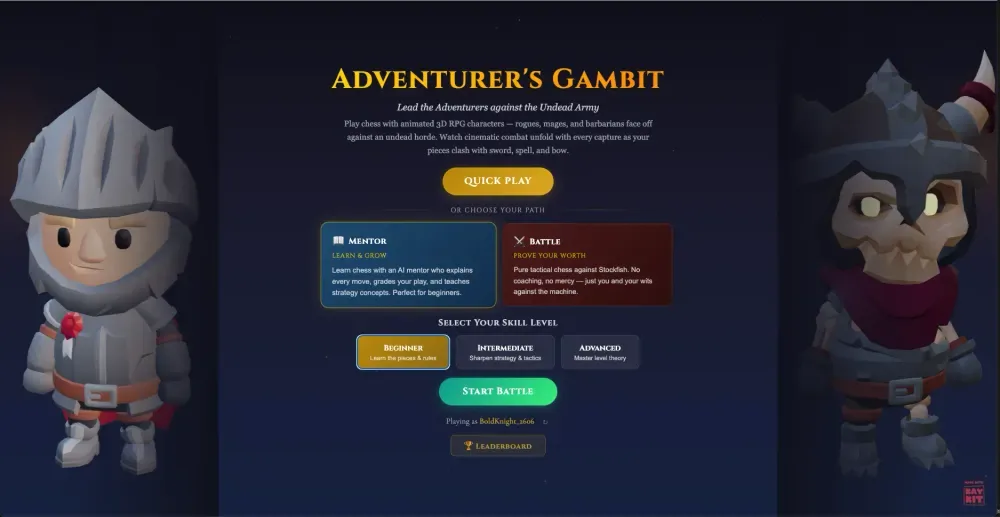
Mentor Mode with difficulty levels
How Amazon Nova Powers the Mentor
The mentor system operates through a carefully designed pipeline that combines the precision of a chess engine with the communication ability of a large language model.
When it is the player’s turn, the backend runs Stockfish at a depth that exceeds the AI opponent’s search depth, ensuring the mentor’s suggestions are objectively stronger than the opponent’s play. Stockfish returns ranked candidate moves with evaluation scores and principal variation lines — the predicted best sequence of play extending several moves into the future.
This structured data is then passed to Amazon Nova 2 Lite through the Bedrock Converse API with extended thinking enabled. The system prompt instructs Nova to act as “The Mentor,” a chess teacher who adapts its language to three learner tiers:
- Beginner tier: Nova explains what each piece can do, avoids jargon, and defines terms when introducing them. “This is called a fork — when one piece attacks two enemy pieces at once.” It tells the players to “move your pawn to c4” rather than “Bc4.”
- Intermediate tier: Nova uses standard chess terminology freely — forks, pins, skewers, fianchetto — and teaches named openings, tactical motifs, and positional concepts using algebraic notation.
- Advanced tier: Nova discusses engine evaluations openly, analyzes pawn structure weaknesses, and references named opening variations and endgame techniques.
Critically, the mentor maintains a teaching memory across the entire game. It tracks which concepts it has already taught (avoiding repetition), records the player’s past mistakes and observed strengths, remembers its previous recommendation and whether the player followed it, and tracks multi-move plans by following Stockfish principal variation lines across turns. This creates a coherent teaching arc rather than isolated move-by-move commentary.
After each player move, Nova grades the move on a five-point scale — excellent, good, inaccuracy, mistake, or blunder — and provides specific feedback explaining why. It also explains what the AI opponent’s move accomplished strategically. Then it presents new candidate moves as multi-move plans: “Push your pawn to d4 to claim the center. If black plays d5, your Knight on c3 supports the center, building a strong pawn duo.”
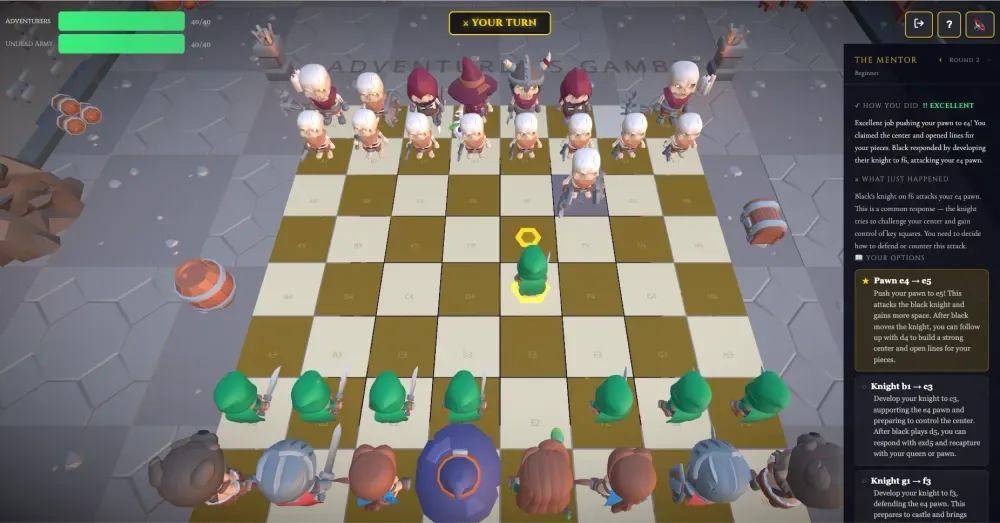
Mentor analyzing the opponent’s move and providing suitable options
Post-Game Analysis: Learning From Every Match
When a game ends, the learning does not stop. Nova generates a structured post-game analysis that reviews the entire match — not a generic “good game” message, but a detailed breakdown of what the player did well and where they can improve.
The analysis draws on the full move history and, in mentor mode, the teaching context accumulated throughout the game: every mistake the player made, every concept they were taught, their observed strengths and weaknesses. Nova synthesizes this into three components:
- A narrative recap in RPG style: “The Rogue Leader’s early center control gave the Adventurers a strong position, but a late-game blunder allowed the Skeleton Mage to break through on the queenside.”
- What you did well: Specific, actionable observations like “Good piece development in the opening — you activated your Rangers and Knights before advancing pawns” or “Found a tactical fork on move 12 that won material.”
- Areas to improve: Targeted advice like “Consider castling earlier for king safety — your Rogue Leader was exposed for 12 moves” or “Watch for back-rank threats when your Barbarians are off the first rank.”
This analysis is calibrated to the player’s skill tier. A beginner sees encouragement and simple language; an advanced player sees precise tactical references. Every game becomes a learning opportunity, and the recap gives players concrete takeaways to apply in their next match.
Technical Architecture
The application is built entirely on AWS services:
- Frontend: React 19 with React Three Fiber for 3D rendering, deployed to S3 and served through CloudFront. Zustand manages client-side state. The 3D character assets come from KayKit’s AMAZING free game asset packs, rendered with skeletal animations for idle, walk, attack, and death sequences.
- Backend: A Hono web framework application running on AWS Lambda. It handles game creation, move processing, mentor analysis, post-game recaps, and ELO-based leaderboards. Request validation uses Zod schemas.
- AI Layer: Amazon Bedrock’s Converse API calls Nova 2 Lite with prompt caching enabled on system prompts. Extended thinking (reasoning) is used at low effort to keep latency tight while still producing structured, thoughtful responses. A JSON repair pipeline handles edge cases in Nova’s output.
- Data Layer: DynamoDB stores game state with TTL-based expiration, teaching context for mentor memory persistence, and a Global Secondary Index for the ELO leaderboard.
- Infrastructure: AWS CDK defines the entire stack as code — Lambda functions, DynamoDB tables, S3 buckets, CloudFront distributions, and IAM roles for Bedrock access.
The application also offers a Battle Mode for players who want pure competitive chess. Battle Mode bypasses the LLM entirely, using Stockfish directly for the AI opponent with configurable difficulty levels. It includes an ELO rating system and a persistent leaderboard, giving players a competitive progression path once they have graduated from the mentor’s guidance.
Community Impact: Making Chess Accessible Through Gamification
The target community for Adventurer’s Gambit is the population of people who would enjoy chess if the onboarding experience were not so forbidding — particularly younger players, casual gamers, and learners in underserved educational settings.
Chess education research consistently shows that gamification increases engagement and retention among young learners. By wrapping chess in an RPG narrative — where capturing a piece triggers a combat animation and the post-game analysis tells you exactly what you did well and what to work on — Adventurer’s Gambit transforms the emotional experience of playing chess. A blunder is not a cold evaluation drop; it is a Barbarian falling to a Skeleton Mage’s spell. A brilliant move is not “+3.2 centipawns”; it is the Rogue Leader flanking the Undead Army’s defenses.
The tier-based mentoring system means the application serves a wide skill range without requiring players to self-assess or configure complex settings. A complete beginner selects “Beginner” and receives jargon-free explanations. An intermediate player gets tactical vocabulary and named opening instruction. This adaptivity is only possible because of Nova’s ability to follow detailed system prompts and produce consistently structured output across different instructional registers.
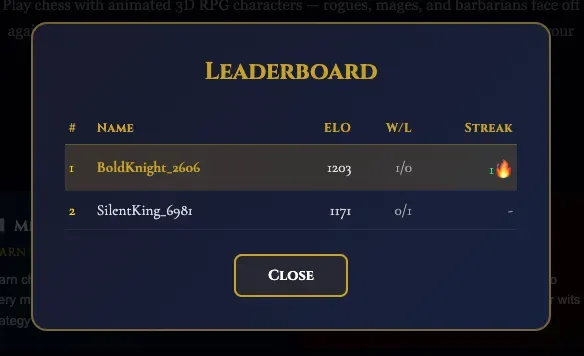
Leaderboard
Real-World Applications
We see several concrete deployment scenarios for Adventurer’s Gambit:
- After-school programs and chess clubs: The RPG theme makes chess immediately appealing to children who might otherwise dismiss it as “boring.” The mentor mode provides individualized instruction that scales — one application instance can teach thirty students simultaneously, each receiving personalized feedback.
- Casual gaming: For the millions of people who play mobile games daily, Adventurer’s Gambit offers a chess experience that feels like a game first and a learning tool second. The Quick Play button drops players directly into a battle with zero configuration.
- Adult education and community centers: Many adults are curious about chess but self-conscious about starting as beginners. The RPG framing and encouraging mentor tone lower the psychological barrier to entry.
- Therapeutic and cognitive development settings: Chess is used in cognitive rehabilitation and elder care. The visual richness and narrative elements of Adventurer’s Gambit may increase engagement in these contexts.
What’s Next
To grow Adventurer’s Gambit into a fuller platform, we plan to:
- Add player-vs-player multiplayer using WebSocket connections through Amazon API Gateway, enabling real-time matches between friends or matchmade opponents. Both players would see the same 3D battlefield with combat animations synchronized in real time, and mentor mode could optionally coach one or both sides.
- Expand language support by leveraging Nova’s multilingual capabilities to offer mentor explanations in Spanish, Hindi, Mandarin, and other widely spoken languages, broadening access for non-English-speaking communities.
- Add puzzle and drill modes where Nova generates targeted exercises based on each player’s observed weaknesses — if the post-game analysis identifies poor endgame play, the next training session focuses on endgame patterns.
- Partner with chess education organizations like Chess in the Schools and similar nonprofits to pilot the application in classroom settings and gather feedback for pedagogical refinement.
Looking Forward
Chess does not need better engines. It needs better bridges — between the complexity of the game and the curiosity of new players. Amazon Nova 2 Lite, through its ability to produce structured, tone-calibrated, context-aware explanations at low latency, makes it possible to build that bridge at scale. Every game of Adventurer’s Gambit is a personalized tutoring session wrapped in a fantasy adventure, delivered through a serverless architecture that costs pennies per game to run.
The 600 million people who already play chess are well served by existing tools. Adventurer’s Gambit is for the next 600 million — the ones who never started because nobody made it feel like an adventure worth beginning.